

Yotta’s India IPO Must Reconcile a $1.5 Billion Raise With Its AI Build-Out
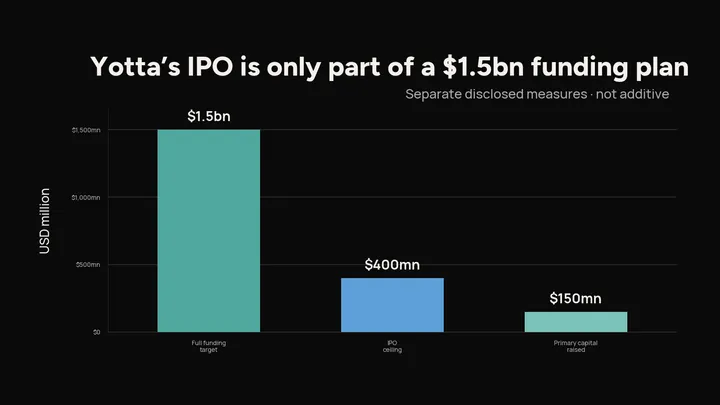
Indian data-centre and cloud operator Yotta Data Services plans to file draft IPO papers in October and seek an Indian listing in the January to March quarter of 2027. Chief executive Sunil Gupta told Reuters that the company is pursuing up to $1.5 billion across pre-IPO and public capital, with proceeds intended for debt repayment, GPU purchases and sovereign-cloud expansion.
That ceiling is larger than the prospective public issue described three weeks earlier. Mint reported that the IPO could contribute up to $400 million, with private fundraising determining the final public component. Investors and customers therefore need the draft red herring prospectus to reconcile several financing routes, rather than treat $1.5 billion as an IPO size.
The capital stack is still provisional
Gupta told Reuters that much of the fundraising target had already been met, but declined to disclose the amount raised so far or Yotta’s current revenue. Reuters separately cited his August statement that Yotta had raised $150 million of primary growth capital at a valuation of about ₹37,000 crore. The undisclosed balance could come from further private equity, the IPO, debt or structures in which partners finance hardware.
Mint’s August interview made the intended sequence clearer. Yotta wants to complete a large pre-IPO round before filing, then size the public offer around the remaining requirement.
“The size of the IPO can be up to $400 million,” Gupta told Mint.
The three disclosed uses do not carry allocation amounts. Debt repayment would repair the balance sheet, GPU purchases would add computing inventory, and sovereign-cloud spending could include data-centre, networking, storage and software capacity. Each use has a different effect on future cash generation, so the DRHP needs to show both the amount and the financing instrument behind it.
Yotta is also considering special-purpose vehicles in which a partner buys GPUs, receives a share of the revenue and transfers ownership after four or five years. Such a vehicle can reduce Yotta’s initial cash outlay. It may also create revenue-sharing commitments, residual-value assumptions or guarantees that are economically similar to financing obligations. None of those terms has been disclosed.
What the filing must distinguish
- cash already received from the $150 million growth round and any later private financing;
- the primary capital expected from the IPO, separately from any offer for sale;
- debt that will be repaid or raised; and
- hardware owned by Yotta, leased by it or financed by partners.
The Indian filing follows a terminated US route
Yotta is a subsidiary of Nidar Infrastructure. Nidar and special-purpose acquisition company Cartica had previously pursued a US listing, but a Cartica filing with the US Securities and Exchange Commission says the parties terminated that transaction on 7 January 2026. Mint reported in August that Yotta had shifted towards India because its sovereign-cloud business and government customer base made a domestic listing a better fit.
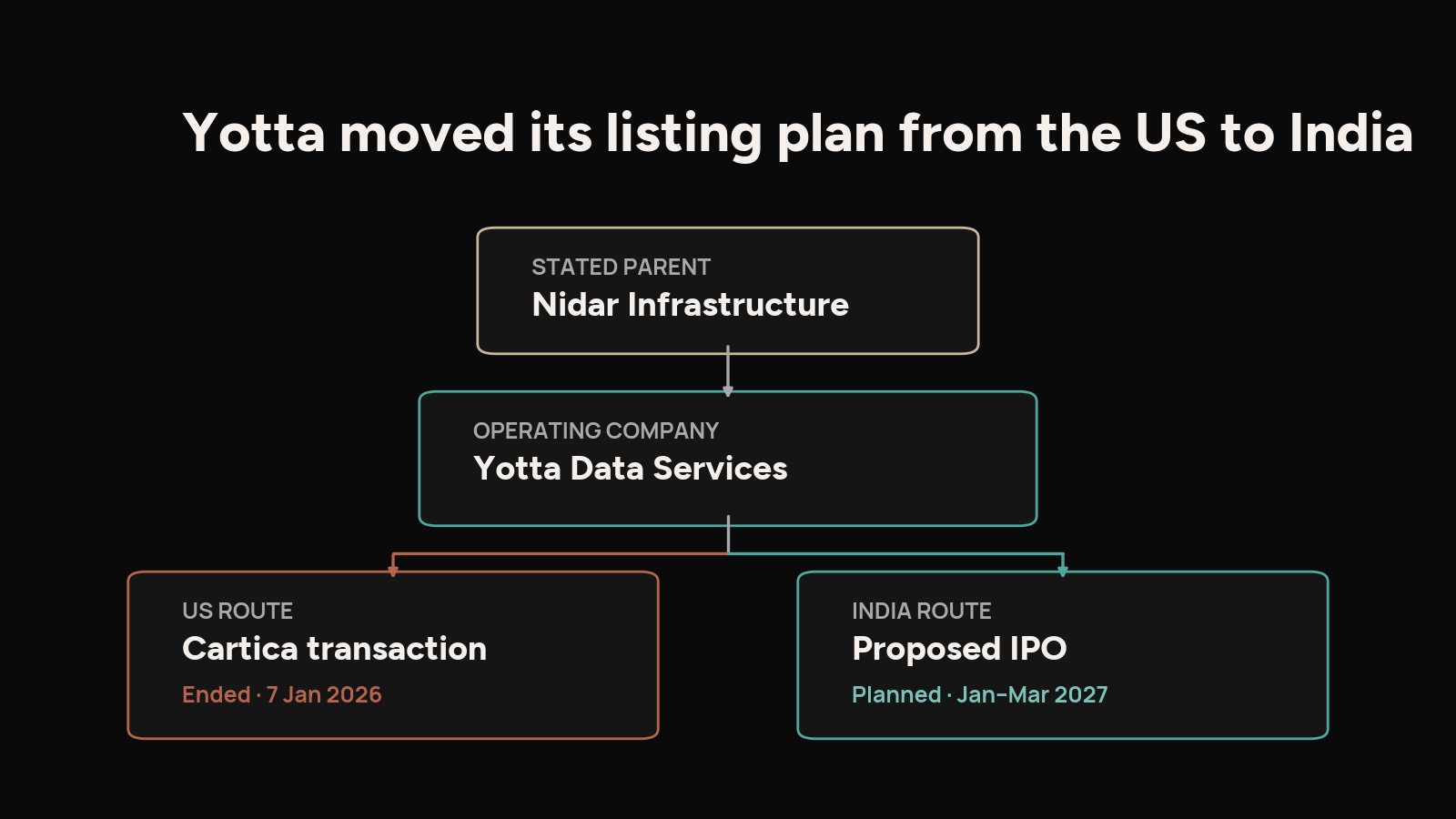
The terminated transaction remains relevant to capital structure. The SEC filing records expense payments, a convertible note and a warrant issued in connection with the termination. Business Index is not treating those instruments as Yotta operating-company debt, because the obligor and group-level allocation require the prospectus. The DRHP should explain Nidar’s ownership, the issuer perimeter, related-party balances and any obligations that sit above or alongside Yotta.
A profitable FY25 does not settle the cash question
Mint reported, citing Ministry of Corporate Affairs disclosures, that Yotta recorded FY25 revenue of ₹890.7 crore and profit of ₹11.1 crore. Business Index could not retrieve the underlying AOC-4 financial statements through the MCA’s authenticated, paid public-document route. The figures are therefore attributed to Mint and should not be read as independently reproduced filing data.
The reported profit corrects the earlier impression that no historical financial information was available. It does not answer how much operating cash Yotta generates, how much debt it carries, or how depreciation and finance costs will change as new GPUs and data-centre capacity enter service. Those reconciliations matter because accounting profit can coexist with heavy investment and rising financing needs.
How Yotta makes money
- colocation and power-linked data-centre services;
- sovereign cloud and managed infrastructure;
- rented AI compute through virtual machines, bare-metal servers and clusters; and
- software and managed services layered over that infrastructure.
The first two can be supported by multi-year contracts tied to space, power and service levels. GPU compute adds shorter technology cycles, supplier concentration and utilisation risk. A chip earns revenue only when customers use reserved or on-demand capacity, while depreciation and financing costs continue through idle periods.
The build-out is larger than the public issue
In February, Yotta announced a deployment of 20,736 liquid-cooled Nvidia Blackwell Ultra GPUs with an investment exceeding $2 billion. It expected the supercluster to go live by August at its 60 MW D2 facility in Greater Noida, supported by Navi Mumbai capacity, and disclosed a four-year Nvidia DGX Cloud engagement valued at more than $1 billion.
No public source reviewed by Business Index confirms that the full 20,736-GPU deployment entered service by the announced August deadline. That is an unresolved commissioning point, not evidence of delay. Installed, energised, contracted and revenue-generating capacity are different measures, and the prospectus should report each one.
Why the figures are not additive
The $2 billion investment and $1.5 billion funding programme cannot be added into one pool. The first is a company-announced infrastructure commitment. The second is a ceiling for private and public fundraising. Supplier credit, debt, customer prepayments and partner-owned equipment could bridge the difference, but their amounts and terms are not yet public.
Competitors are raising capital on different bases
Yotta’s latest disclosed comparison with domestic data-centre operators is directional because capacity definitions and target dates differ. Mint’s August reporting on Sify Infinit provides a common set of variables: active capacity, expansion capital and listing status.
- Sify Infinit disclosed 113 MW of active capacity as of June 2025 and a plan to raise up to $4 billion over four years. Its IPO was deferred, according to Mint.
- CtrlS announced a ₹4,000 crore raise in June to expand its data-centre footprint, while Nxtra announced $1 billion of investment in March. Public sources reviewed here do not provide a like-for-like current active-capacity measure for both on the same date.
Yotta reported 180 MW of installed capacity to Mint and targets 800 MW by 2029. Its combined FY27 fundraising target is $1.5 billion, and it plans an Indian IPO by March 2027.
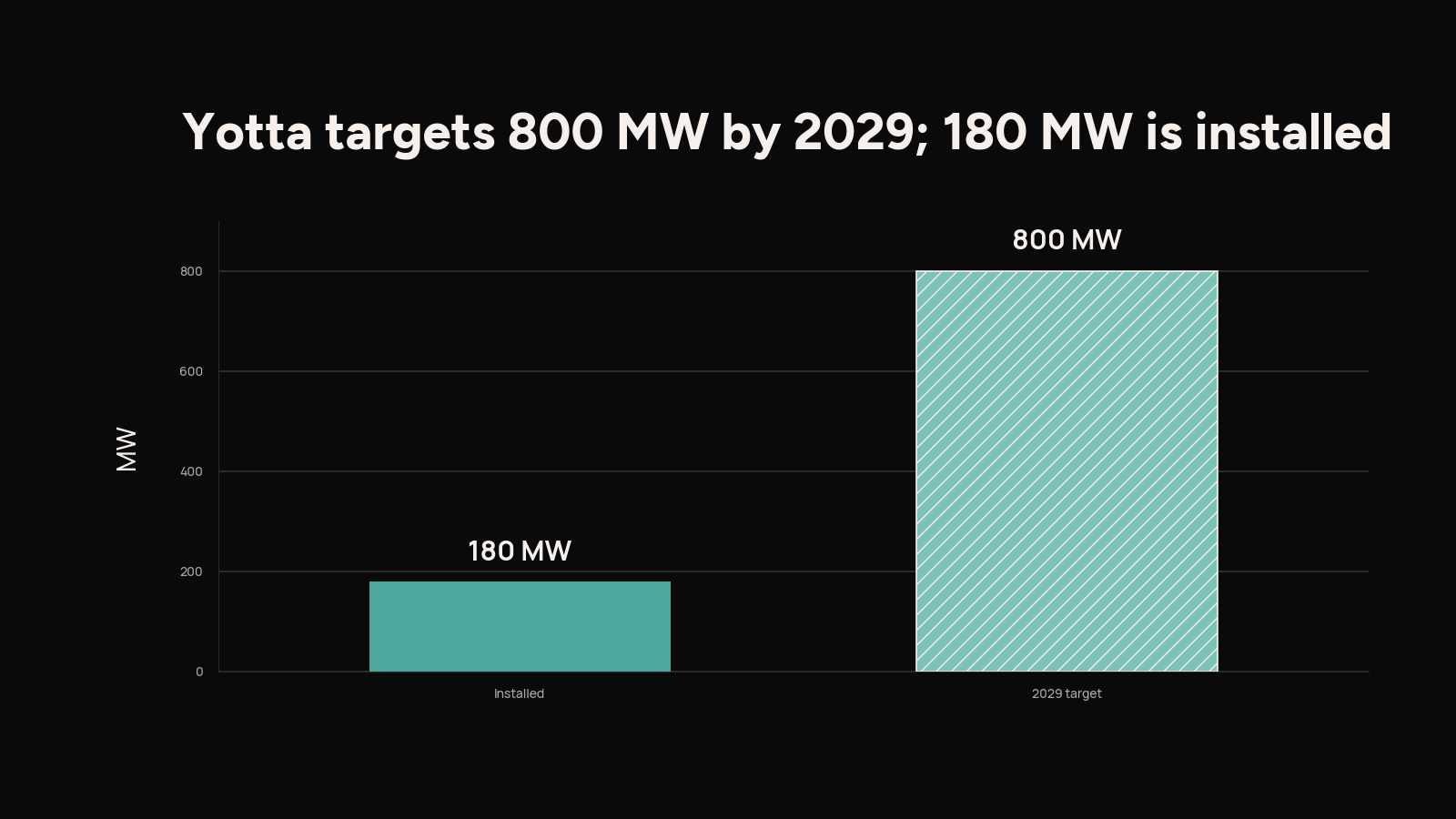
These figures do not establish a ranking. They show that public equity is one financing route inside a broader domestic capacity cycle. Yotta differs from a conventional colocation operator because its requirement includes GPUs, high-density cooling, networking and storage as well as powered shells.
Customers will feel the financing through availability and terms
More domestic compute can improve access for Indian model developers, enterprises and government agencies. The IndiaAI allocation register lists 4,096 H100 GPUs from Yotta for Sarvam AI. An August partnership with IntelliDB also shows Yotta extending beyond raw compute into managed database services for regulated and government users.
The customer benefit depends on commissioned capacity and contract terms. Successful financing could increase local supply, shorten waits and widen the set of managed services available in India. A slower build-out could leave announced GPUs unavailable when training or inference demand arrives. Partner-financed hardware may accelerate deployment, although revenue-sharing commitments can influence the minimum prices and contract periods Yotta offers customers.
Export demand changes who gets capacity
Export demand introduces a second allocation question. Reuters reported that overseas clients account for 75% to 80% of Yotta’s customer base. The Union Budget 2026 speech proposed a tax holiday until 2047 for foreign companies serving global customers through Indian data centres, with Indian customers served through an Indian reseller. That proposal can support utilisation, while the prospectus still needs to show whether domestic programmes or reserved contracts protect access during periods of scarce capacity.
What October’s DRHP has to reconcile
The prospectus should turn Yotta’s capital announcements into one audited bridge. The essential disclosures are:
- FY24 and FY25 revenue, profit, operating cash flow, debt and finance cost on a consistent issuer perimeter;
- capital expenditure paid, committed and still subject to financing;
- operational GPUs by model, campus and commissioning date;
- owned, leased and partner-financed hardware, including revenue shares and guarantees;
- contracted capacity, customer concentration, utilisation and pricing commitments;
- the use of IPO proceeds, with amounts for debt repayment and growth spending;
- Nidar’s ownership, related-party balances and obligations connected with the terminated Cartica transaction; and
- power, cooling and network readiness for the Blackwell deployment announced for August.
Yotta enters the filing process with a reported FY25 profit, operating campuses, government compute allocations and large customer and supplier relationships. The open question is how those assets convert into cash after hardware, power and financing costs. A DRHP that reconciles the issuer perimeter, capital instruments and commissioned capacity would make that economics visible. Without those bridges, capacity economics would remain unresolved even if demand for Indian AI infrastructure continues to grow.
Sources
One email. Saturday morning.
The week that mattered.
The five stories you needed to read, the data point of the week, and what to watch. From Business Index editors. No ads, no fluff.